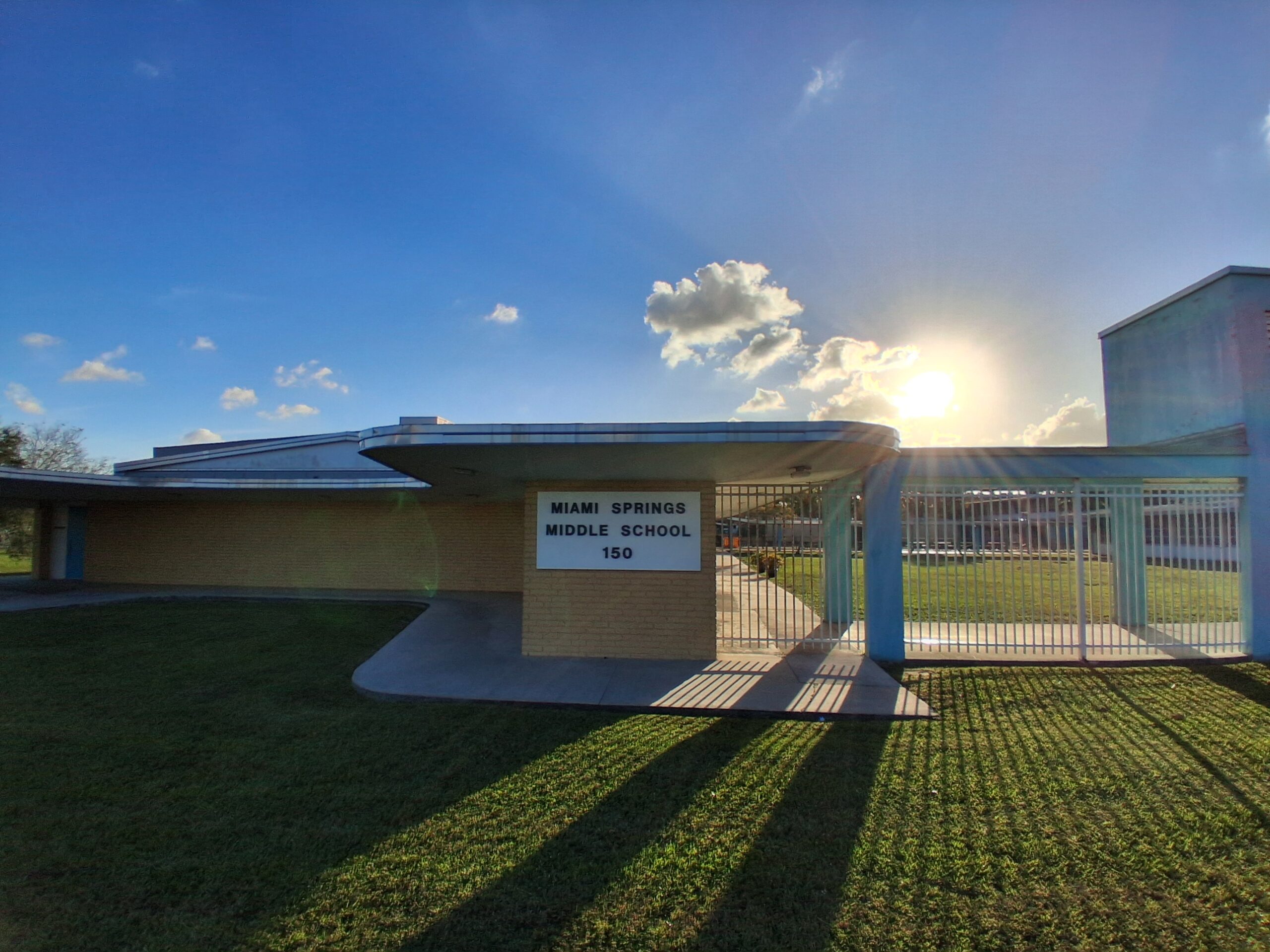
Miami Springs is at an important crossroads in public education — one shaped not by
theory, but by reality. For years, families in Miami Springs, Virginia Gardens, and Medley. The River Cities have increasingly chose alternatives to the local middle school. Enrollment has declined, facilities have aged, and despite the best efforts of educators, the school’s reputation and performance have struggled to recover. The result has been a cycle familiar to many communities: fewer students lead to fewer resources, which in turn makes improvement even harder. That context matters when evaluating the proposal now moving forward — the conversion of Miami Springs Senior High School into a 6–12 campus, currently referred to as Miami Springs Preparatory Academy, a 6–12 School. While the name is still a working title, it reflects the broader academic mission and long-term college and career readiness goals being advanced.
The plan was formally presented during a required town hall on attendance boundary
changes, but as Miami-Dade County Schools School Board Member Danny Espino of District 5 made clear, this is far more than a boundary adjustment. “This was not just about moving lines on a map,” Espino said. “It was about developing a real educational solution for Miami Springs.” As of last year, fewer than 40 families from Miami Springs, Virginia Gardens, and Medley were enrolled at the local middle school. Many families have instead turned to charter schools, private schools, or public schools outside the area — particularly in neighboring communities with newer facilities and broader offerings.
“The truth of the matter,” Espino explained, “is that the middle school needed not only a
significant capital investment, but also curricula and personnel that the enrollment simply
does not substantiate.” Rather than attempt to rebuild the middle school with insufficient enrollment, the district explored a different approach — one that reflects broader trends in education. Parents increasingly favor school models that reduce transitions. K–8, 6–12, and even K–12 campuses have grown in popularity because they offer stability, continuity, and clearer academic pathways.
“We know parents want fewer transitions in their children’s educational journey,” Espino
said. “In a 6–12 setting, students make one major transition at sixth grade, and by the time they reach ninth grade, there are no jitters — they’re already part of the culture.”
Miami Springs Senior High is uniquely positioned for this shift. The campus has ample
capacity, and more importantly, access to opportunities that a traditional middle school —
even a fully enrolled one — cannot provide. Under the proposed model, middle school students would gain early exposure to high school academies such as law, medicine, aerospace, logistics, and Cambridge-style coursework. Advanced students could take higher-level classes earlier, with credits counting toward graduation.
Extracurricular opportunities would expand significantly as well. Athletics, clubs, and arts
programs — funded at higher levels in high schools — could now be extended to younger
students. In some cases, qualified middle school students could even participate in junior
varsity athletics before reaching ninth grade.
“All of those things feed into why 6–12 schools are such an attractive offering,” Espino
noted. The proposed school would serve as both the neighborhood school for Miami Springs, Virginia Gardens, and Medley, and as a school-wide magnet. Families within the attendance boundaries would attend by right, while magnet programming would offer specialized academic tracks. Equally important is what this proposal does not do.
The existing middle school campus will not be sold, rezoned, or converted for commercial
or residential development. It will not become a strip mall, and it will not be designated as a “school of hope.” Instead, district leaders are exploring educational and community-focused uses for the site, including early childhood education, after-school tutoring, special needs programming, and potential co-location of municipal services.
I believe this is a great idea — and I say that as someone who grew up here.
I attended Miami Springs Middle School and left after sixth grade because it simply wasn’t
working for me. That was back in the 1990s, and while time has passed, the pattern is
familiar. When families don’t feel confident in a school, they look for alternatives.
Miami Springs Senior High clearly has the space. When I was in high school, the senior lot
was full every day — so was the overflow lot across the street by the baseball fields. Today,
occupancy is noticeably lower.
If I were a parent in Miami Springs today, I would feel far more comfortable sending a child
to an integrated 6–12 environment — one with consistent expectations, broader
opportunities, and a clear academic trajectory.
The attendance boundary process is expected to conclude with a school board vote in May
or June, with implementation anticipated for August. Between now and then, district
officials will continue facility planning, operational preparation, and outreach to families.
Change is never easy, but standing still is not neutral. This proposal recognizes reality,
responds to long-standing concerns, and offers a forward-thinking solution that keeps
students in the community while expanding opportunity.